The 300 – neither the Spartans nor this year’s Bluecircle spruce survived

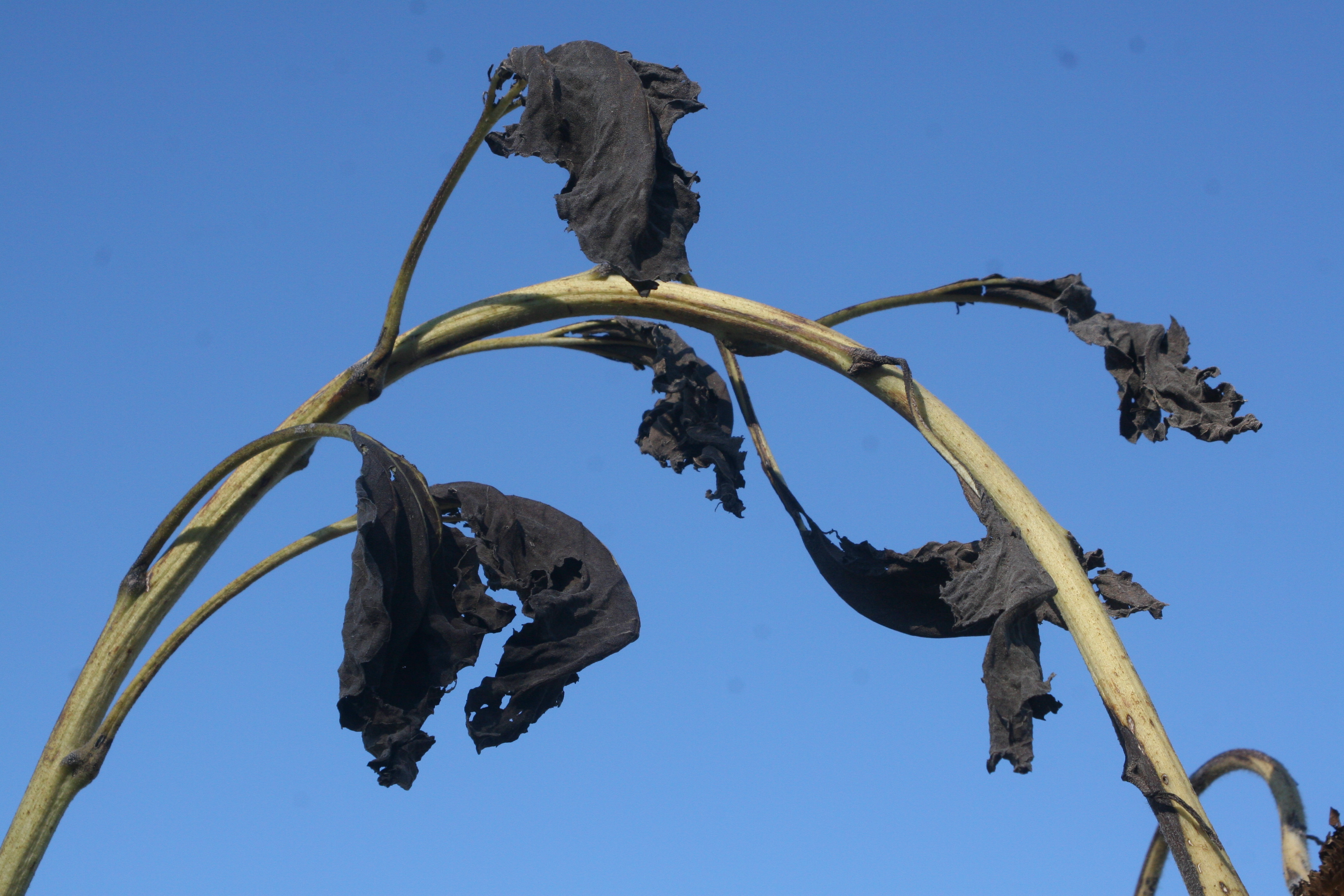
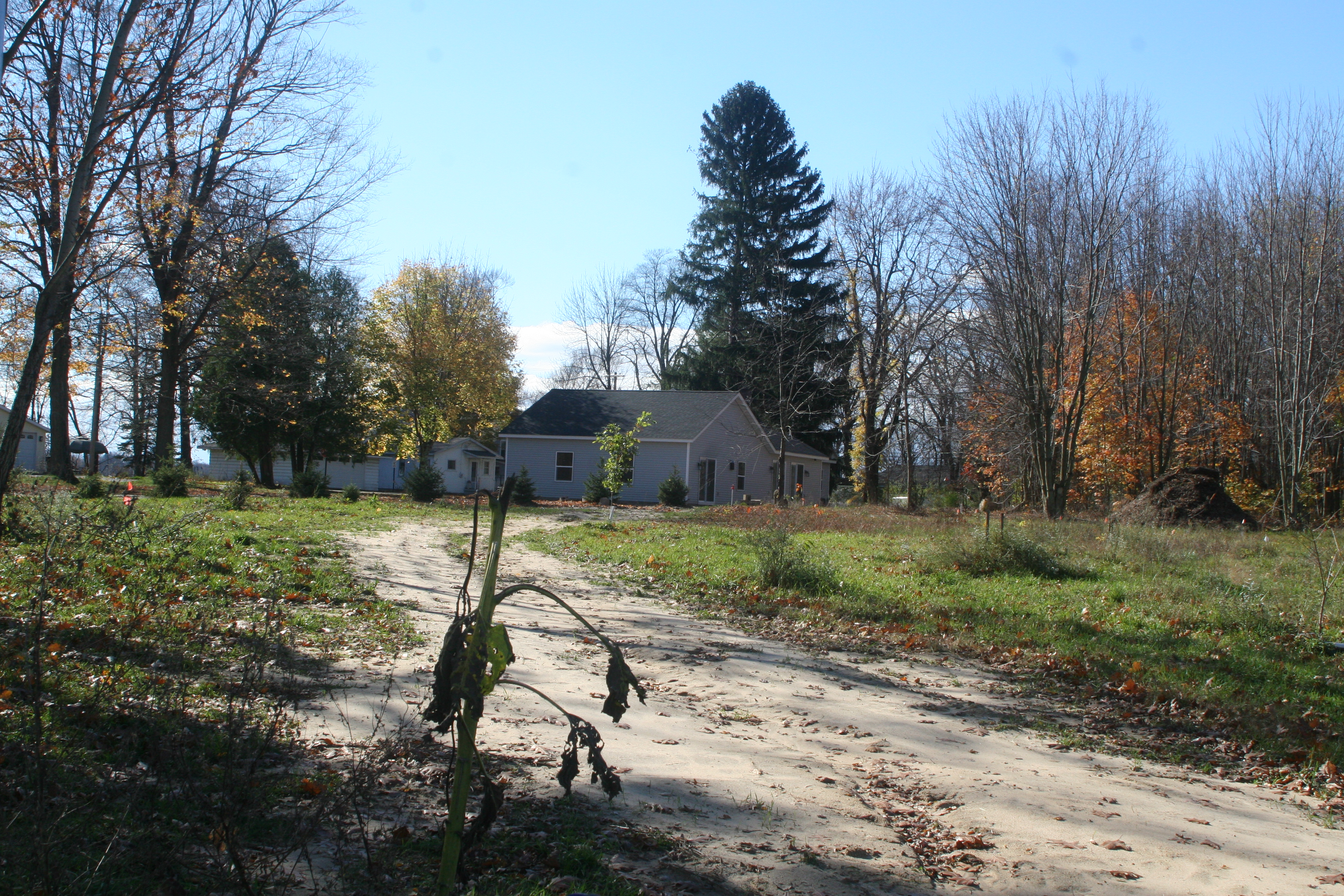
Anyone living in southwestern Michigan or Indiana continues to suffer through one of the hottest and driest periods in the last century.  Needless to say, this was not an auspicious year to start a spruce forest in Berrien County.   In general the smallest seedlings have survived (so far), but even the strongest soldiers from the County Conservation District tree sale that managed to produce “candles” and then new needles have succumbed to days of hot sun, dry winds and rare rainfall.  The weeds we banished from this acre are showing their vigor and retaking the field despite the arid conditions,  so the only choice is to hook up the bush hog and try again next year.

In retrospect the strategy to mulch the seedlings with VisPore tree mats, a porous and biodegradable black fabric for weed control, may have compounded the poor weather conditions.  The sandy loam soil in this part of the Bluecircle dries quickly.  The same mulch appears to be working well in plantings of walnut and established pine, but we will rely on mowing to manage weeds in the rest of this year’s seedlings.

300 seedlings – plotting a white spruce mini-forest

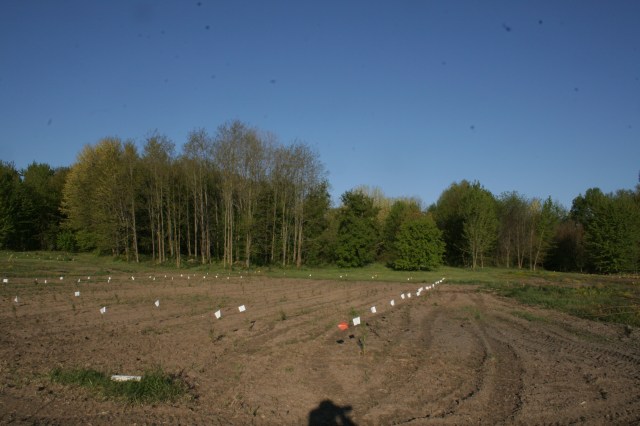
On a dusty Friday evening in mid-April we tree-spade planted 200 spruce seedlings from the Berrien County Conservation District tree sale.  The rows and spacing were premarked and this took about 4 hours.   Although some of the seedlings are 18″ tall the tree flags will become critical in a month or two when rapid weed growth can be expected.  This year we intend to mulch transplants that look healthy in May to reduce the amount of mechanical weed control and provide some protection against dry weather later in the summer.  Spruce grow rapidly once established, and could reach 30′ in height in 25 years.

The week of 700 trees

OK, so maybe it was only 690 or perhaps 710.  The recent silence of this blog has been the result of a couple of months of planning, then tilling, and most recently planting the majority of the Bluecircle hilltop with white spruce, white pine, scotch pine, and Douglas fir seedlings.  As an experiment a shady area was planted with Canadian hemlock, and 25 tiny white cedar have the potential (I hope) of maturing into a property line hedge.  A dry mid-April has been followed by a few heavy rains, but an actual inventory of the “likely to survive” in each planting will have to wait at least a few weeks.  Things that worked well this planting season were the excellent size and condition of seedlings from the Berrien County Conservation District annual tree sale and the well-prepared field thanks to neighbor George’s hours running our 5-foot tiller.  Once the rows and spacing were laid out it was easy to plant an average of about 50 seedlings/hr with the tree “spade” or  planting blade.  What did not work out so well was an effort to clear an area of roots and small stumps with a “potato” plow that lacked a shear pin – the cross-member angle iron failed and the resulting bends broke several welds.  Breaks in the drive chain on the tiller have also been problematic, resulting in significant time in the barn doing repairs.  

Biographical sketch of William J Myers, Ohio farmer

The following biographical sketch was based on notes from The Dilbones of Ohio, by O.L. Myers (unpublished):

WILLIAM JAMES MYERS: William was the first born child of Lafayette Myers and Elizabeth nee Leslie Myers. A birth certificate prepared on November 21, 1942 to allow him to work in a defense plant during World War II states that he was born July 31, 1886 in Hale Twp., Harding County, Ohio. A copy of this record signed by a sister to his mother and a brother to his father is believed to be correct, although his obituary states than he was born in Logan County, Ohio. Willie, as he was called by his mother, spent his early youth in and around the lake at Russels Point, Ohio. This lake had been constructed as a feeder to the Erie Barge Canal which connected Cincinnati and Toledo, Ohio. Sometime prior the age of twelve his family moved to Middlepoint, Ohio where his father was employed at the France stone quarry. He attended school only through the fourth grade and at about the age of 10 he was hired as a stone quarry waterboy at the rate of 25 cents per week. In his later years when he coughed Willie would often say, “bless the old stonehole anyway.” While his formal education ended early he continued reading and working on his mathematics and was a capable teacher to his children through their elementary grades. Being a large man he did some boxing in his youth and remained active in the social activities of the community. William was married twice. His first wife was Mattie Albright. A son, Eli Albright and daughter, Eva Lucille were born to this union on Sept. 5, 1911 and May 8, 1917, respectively. Mattie developed a bloodstream infection after giving birth to their daughter and died a week later. William was overwhelmed with grief and his weight fell drastically – the doctors also feared for his life. His family believes that Mattie’s death caused him to renew and then rely on his religious faith put his life back together. He remained active in his community churches for the rest of his life. In 1918 William met Ethel Leota Dilbone, a young telephone operator in Rockford, Ohio who would always call him Will. They were married the next winter. Will continued to farm until economic conditions of the early 1920’s forced them off the farm and back to Middlepoint, Ohio. He found work as janitor for a Normal School. After their first child, Owen Lafayette, was born in 1921 they moved to Celina, Ohio where his father-in¬-law operated a farm and dairy business. While working in the dairy he joined his brother-in-law in owning and operating a meat market in Celina. However, when an opportunity arose for them to get jobs in the Fort Wayne, Indiana shops of the Pennsylvania Railroad Will moved his family to Maples, Indiana. His daughters Margaret Louise and Mary Helen were born there in 1923 and 1925, respectively. Unlike his brother-in-law who was a railroad employee for another 40 years, Will remained a farmer at heart and in early 1926 he returned to farming. His oldest son, now 15, Ethel and he worked side by side with the goal of raising enough cash for their own farm. The first year they were tenant farmers in Allen County, Indiana, the following year farmed near Monroeville Indiana, and in 1928 returned to rent land near the village of Wren in Van Wert County Ohio. The next Spring they moved to work a farm owned by his mother’s widowed sister in Ridge Twp, Van Wert County, and the following two years made smaller moves to other farms in the same township. The family would remain at this last farm for the next 4 years. A fourth child, James was born there. The economic crisis of 1929 swept over the nation and the Great Depression began. Banks failed, shops and factories closed. Land prices fell, then fell again and many Ohio families lost their farms and homes. Will and his family were fortunate – the bank that held their savings did not fail. So in the worst of times, 1931, he and Ethel were able to purchase their dream, an 80 acre farm in Union Twp., Mercer County Ohio. Despite the sheriff’s sale price of only $23.33 an acre now he had both seven children and a mortgage on the farm. They delivered fresh to the stores in nearby Mendon where it sold for 5 cents a quart. Beef and hogs were butchered and sold door to door from the back seat of a ten year old car. By the outbreak of WWII the mortgage was paid. Five of the children were now gone from home and Mr.and Mrs. Myers begain to deal in real estate. They sold their Union Twp. Farm and both worked at the Lima, Ohio Tank Depot during the war. Over the next 15 years of semi-retirement Will farmed a little, but spent more of his time buying, renovating and then selling several farms and houses in and around Mendon, Ohio. They finally retired in Van Wert, Ohio where they purchased a frame house that had been built by their son Owen in 1950. Even then they were not far from their farm roots – the floor joists in the house were salvaged lumber from one of Will’s barns. They raised vegetables in their backyard garden, canning what they could not eat fresh. In May, 1969 Will fell from a stepladder while retrieving the canning supplies from storage and fractured his tibia. His fracture healed uneventfully, but on June 8, the morning after removal of his leg cast he suffered an acute and fatal pulmonary embolus and died at home.

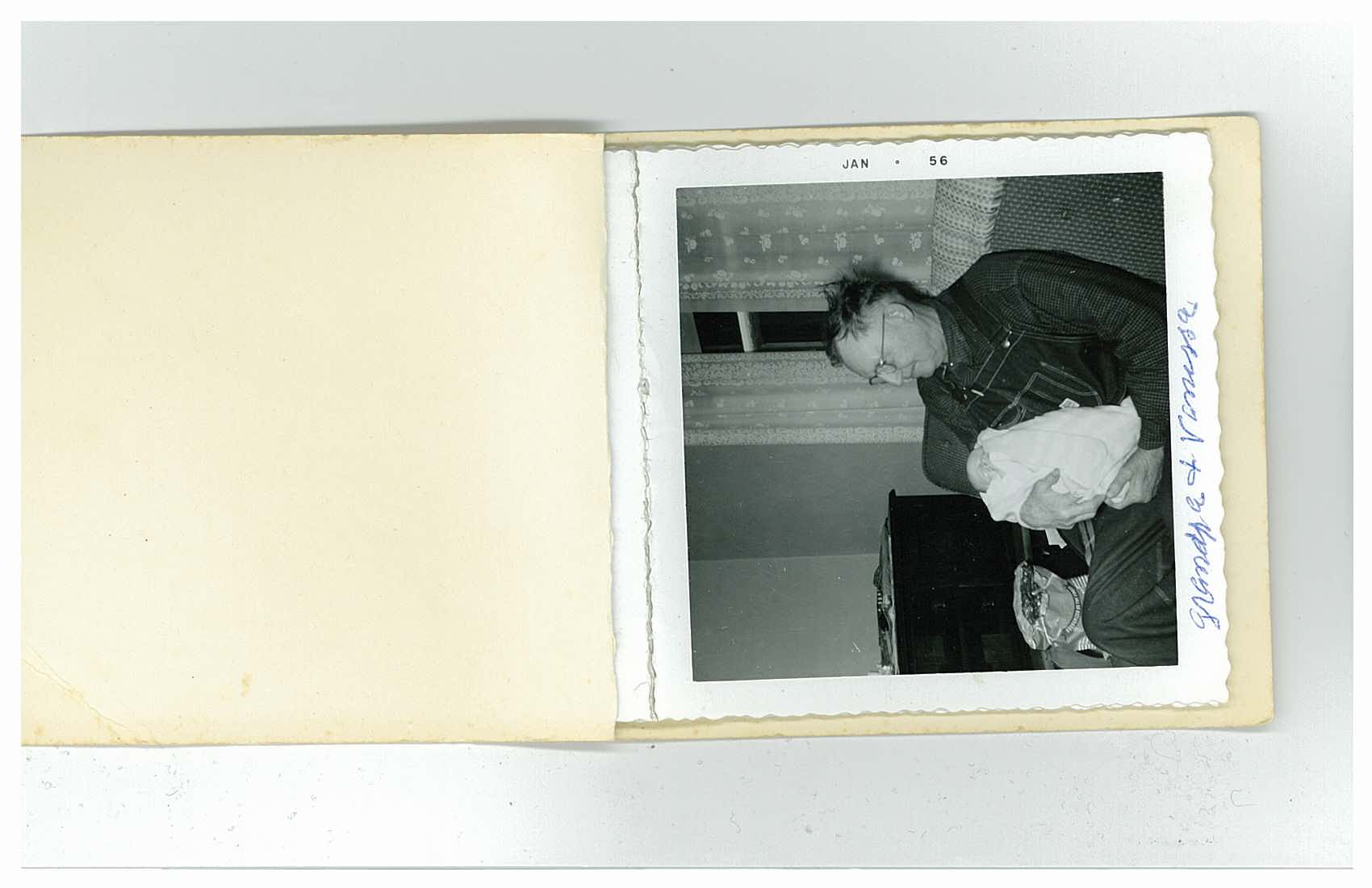
Will Myers and a granddaughter, 1956
A Winter of interrupted sleep

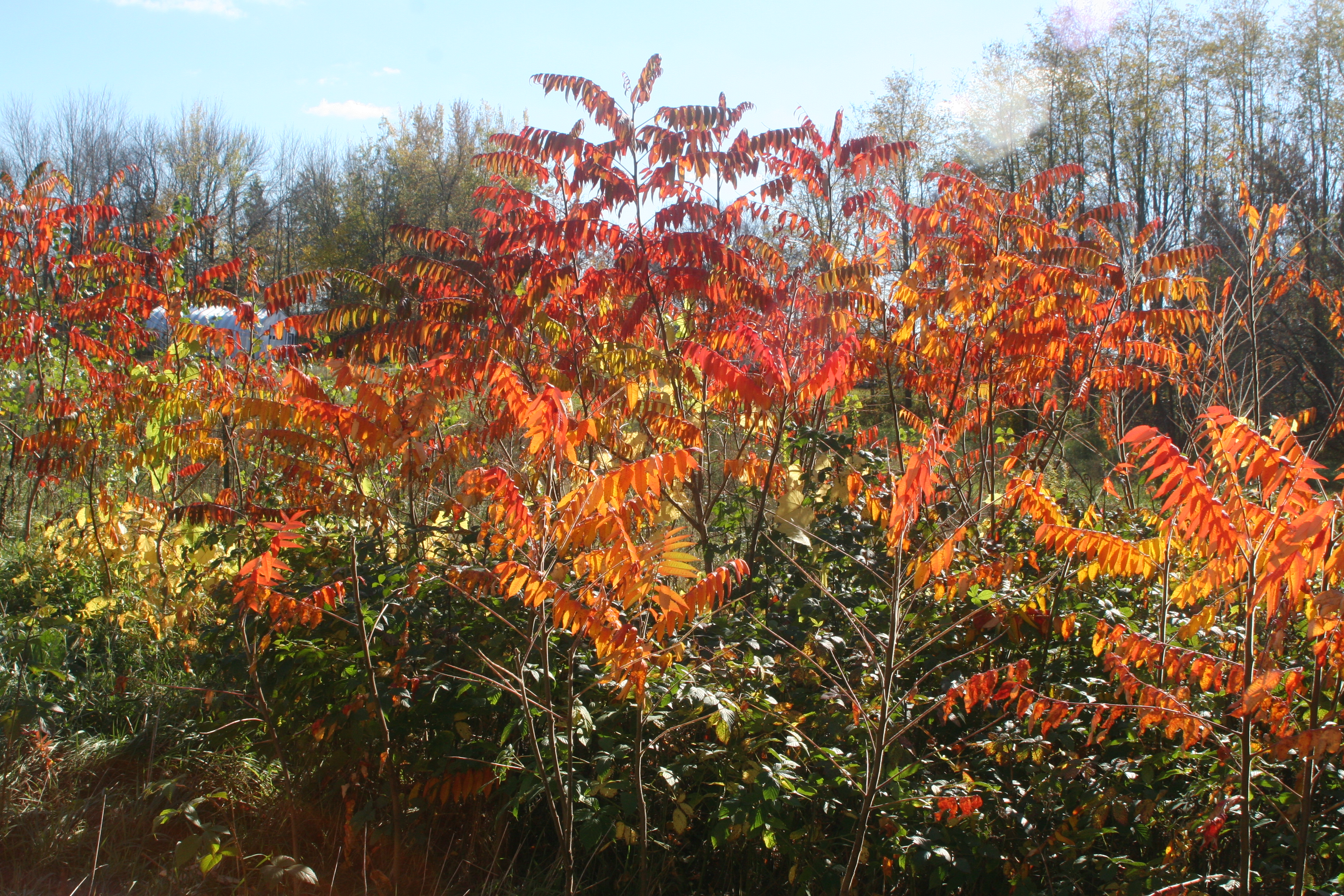
The Bluecircle has not slept well this Winter, with only short periods of snowcover interrupted by warming winds and rains. The heavy lake-effect snows of 2009 and 2010 have been absent, and today it looks and feels like March. The grapes will winter well, but so will insects that routinely fail to survive dry, cold weather.
The perimeter of the farm was posted “No trespassing” as a rather unneighborly way to keep snowmobiles at bay and avoid damage to fledgling trees.  Since the ground remains soft and relatively warm snowmobiles will not be a significant threat this year.  Groundhog day approaches – I wonder if the land will notice its shortage of restful slumber.

A short history of Smith’s Landing

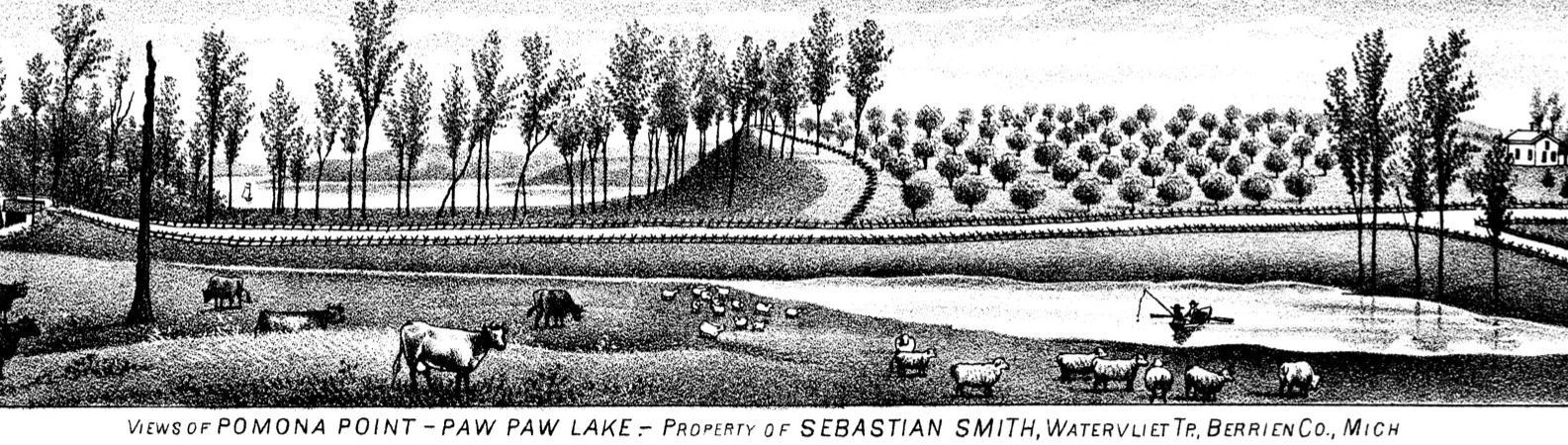
Sebastian Smith was an early resident of Watervliet who moved from Maine in 1854.  He eventually owned approximately 100 acres of orchards and even shipped apples to England.  Engravings depicting his farm and the outlet bay of Paw Paw Lake accompany a 1890 biographical sketch of him in History of Berrien and Van Buren Counties, Michigan
 With Illistrations and Biographical Sketches
of Its Prominent Men and Pioneers.
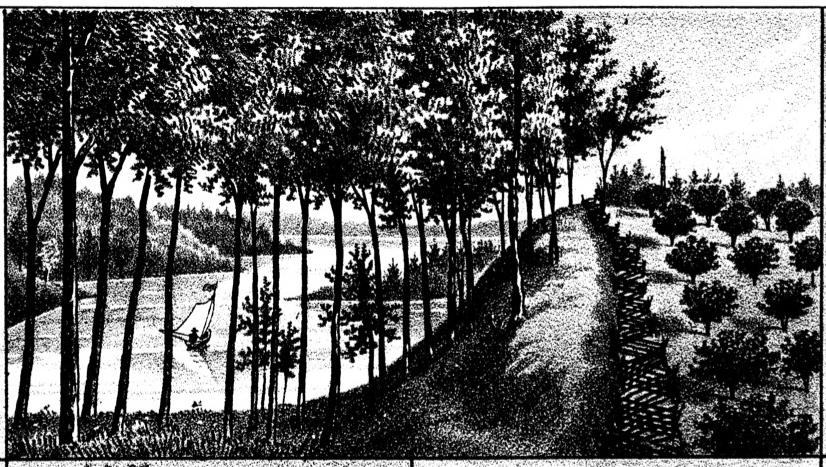
 D. W. Ensign & Co., Philadelphia 1880.   In these images his orchard extends over the hill that would be platted as Fair View in 1922 and the adjacent Bluecircle farm land.  His cows graze along the road that rounds the bay and lies at the foot of the hill known in 1900 as Hetherington Hill.  Until 1960 this road, identified as M11, would remain a main route connecting Chicago visitors with northern destinations in Michigan.  In the 1880s he built a pier here that would identify the adjacent lakeshore as Smith’s Landing.    What has been described as the first cottage on Paw Paw lake would be built there in 1887, another would be located “in Sebastian Smith’s cowpasture”, and within a few years lakeside development had blossomed at several locations around the lake.  This period of Paw Paw Lake history is reviewed by R.L. Rasmussen in Paw Paw Lake – A 100 Year Resort History (1890’s-1990’s) Southwestern Michigan Publications, Coloma MI.

Smith’s pier was only a hundred feet from the short stream that connects Paw Paw Lake to the Paw Paw River.   Watervliet’s shops, lodgings, and a rail depot were two miles downstream and for some years steam launches navigated the shallow waters.  Even larger steamboats ferried passengers around the lake itself as tourism and resorts proliferated in the early 20th Century.   Today the site of Smith’s pier endures as a Watervliet Township swimming pier and small park, the last remnant of the public beaches of Fair View.  When Abraham Botto purchased Smith’s Landing from Sebastian Smith the boundaries of the property must have been poorly defined.  Botto’s estate remained in and out of probate court from 1920 until 1949 before a conventional description of Fair View was entered by his daughters and Smith’s Landing was finally laid to rest.

Gaff-rigged sailboat at Smith’s Landing

Are poplars afraid of the dark, or the trespass of sodium lights?

Poplars bathed in a sodium nightlight

Having lived mostly in urban areas it is memorable when the lights go out in the basement and true feel-your-way darkness begins.   Such blackness never occurs outdoors in our cities, and increasingly prevalent “security lighting” is making it difficult to find a dark night even in rural areas.  “Light trespass” is a term used to describe undesirable and sometimes completely unacceptable illumination across property lines  (www.darksky.org/assets/documents/is076.pdf ).  In recent years several Michigan communities with long histories of tourism and respect for the environment have enacted ordinances that regulate outdoor lighting, especially when it creates glare or encroaches on property lines.  Do trees, the permanent residents of this hillside,  mind this sort of nightlighting?

For people, it will be several years before the poplars planted just south of this powerful “security beacon” provide sufficient screening to make campfires or any recreational use of this area enjoyable even in summer.   In the meantime the “sodium cityscape” is on display.

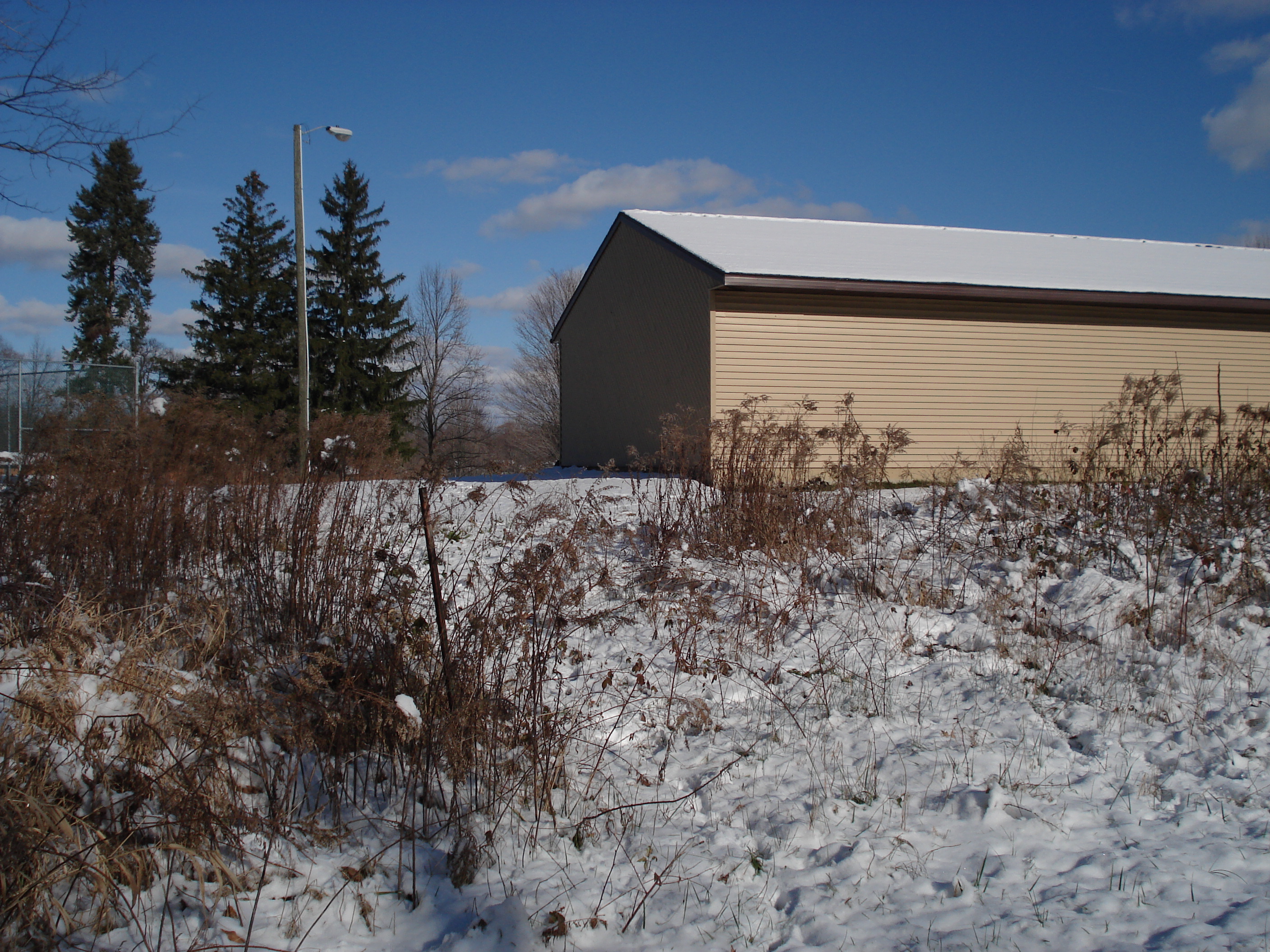
An unshielded streetlight-type luminare placed too high and close to the property line produces light trespass

Findings of a maple’s autopsy

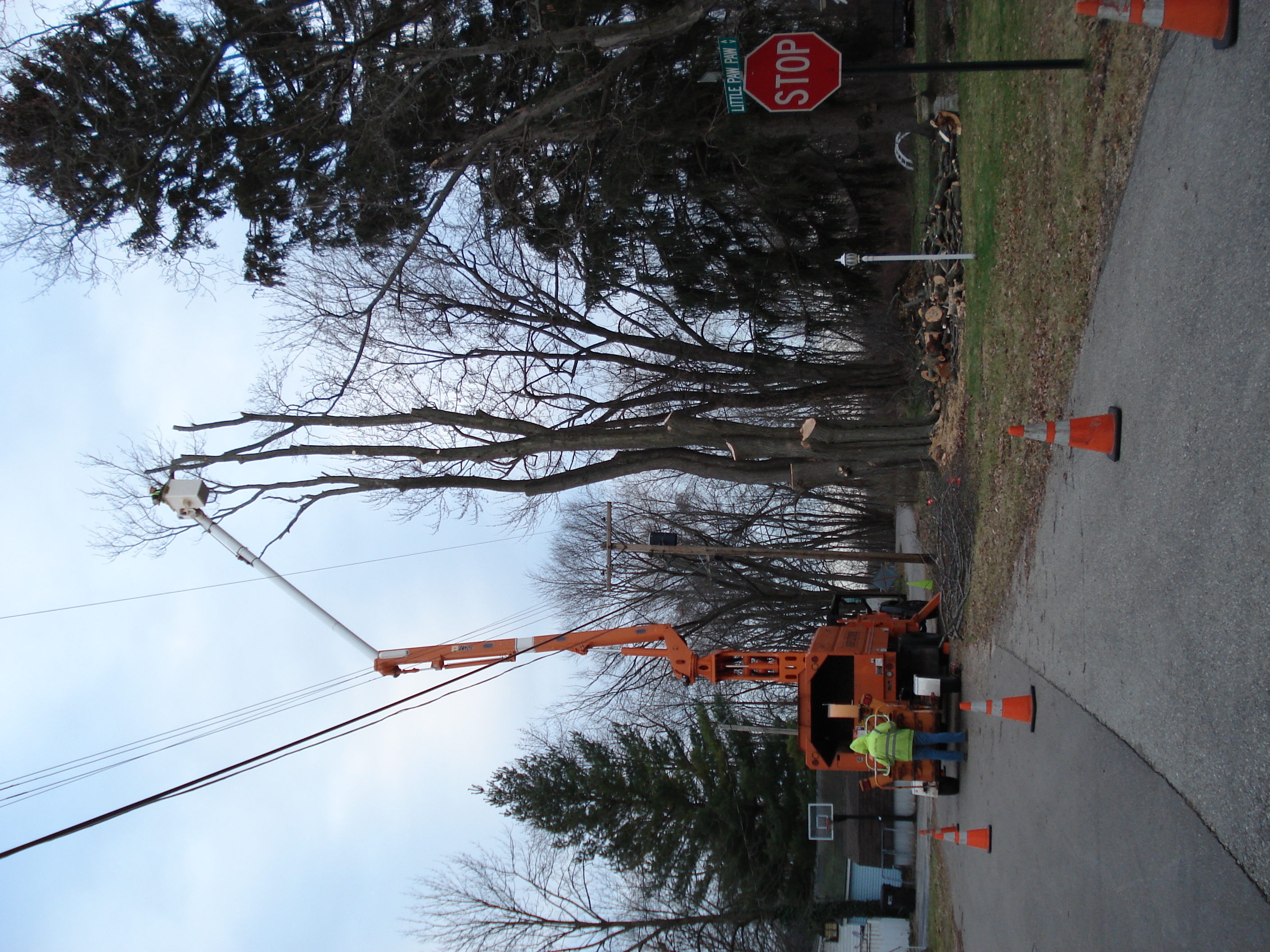
Saw work at the top of the high lift

The “tree doctor’s” diagnosis of our nearly 100-year old maple’s terminal condition proved correct.  The sawn trunk sections of our recently felled maple revealed a deep split from “12 o’clock to 6 o’clock” across the middle of the trunk, and a second split at “9 o’clock” that intersected the first at a right angle.  One of the several main divisions of the trunk was hollow and segments of it broke on impact with the ground despite their shell of live wood.  Because of the proximity of power lines and the mature pine   just north of the maple the tree removal took nearly 3 days, but was accomplished without any interruption of electrical service.  Nice work, tree surgeon!

50:50 split of an old maple trunk

When it snows you can see – the first pines of the Bluecirclefarm!

First December snow

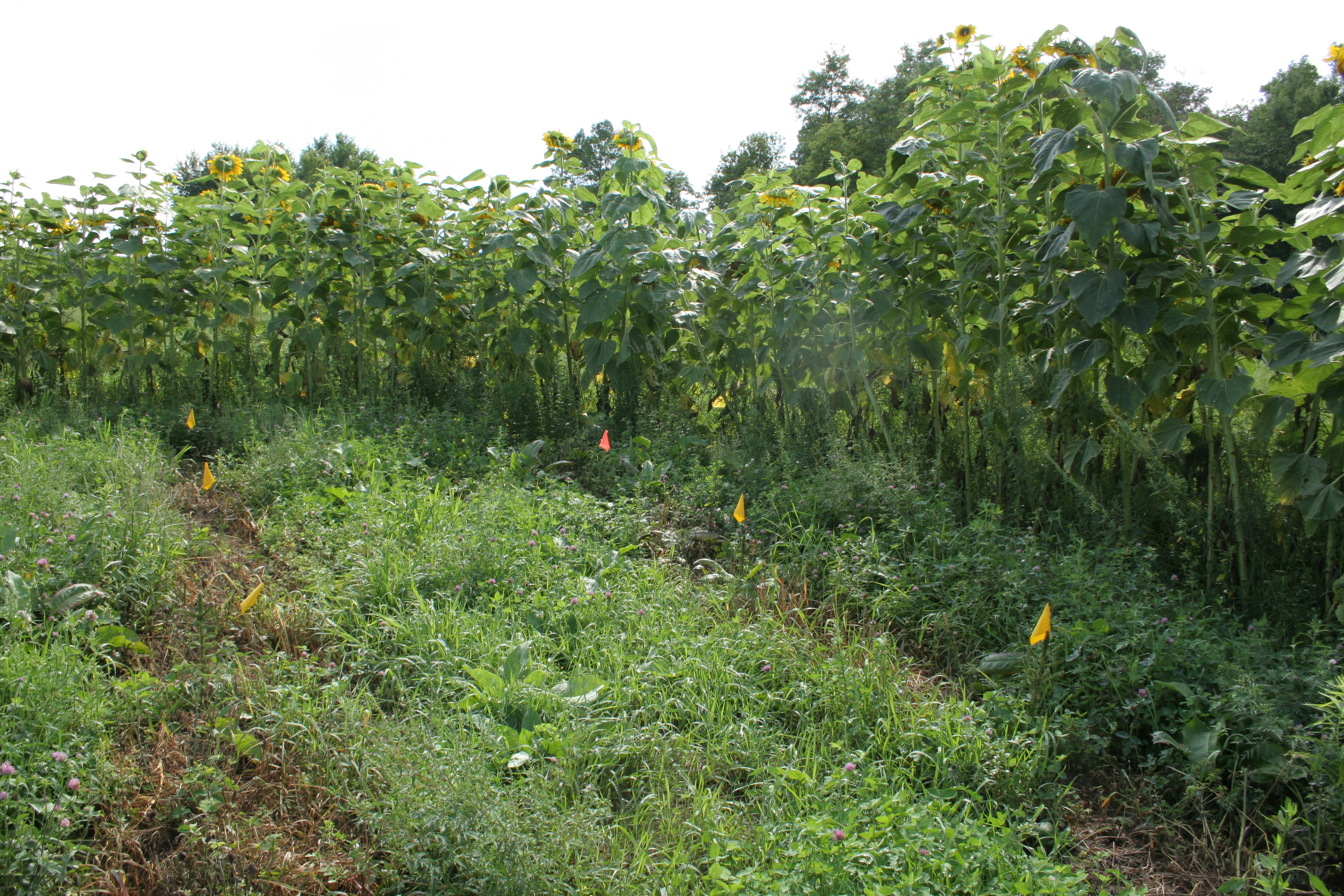
On a couple of frosty, muddy mornings in March and early April the first rows of trees planted in the Bluecircle were Douglas fir and Norway spruce seedlings from Burgess Seed Co. and the Berrien County Conservation District.  The summer was relatively wet, and both trees and the abundant weeds prospered.  Even with mowing and some cultivation it has been hard to see the trees for the ragweed, red clover, thistle and even poison ivy, but with the first snow the survivors are now visible alongside their marker flags.  Overall about 85% of the 160 seedlings made it through their first growth season, which was better than I expected.   A lessons-learned note about poison ivy in the Spring – bared-handed planting in March is to be avoided even when your gloves are wet unless you don’t mind following up with 2 weeks of treatment for the ivy rash!  A tree spade works just as well and doesn’t mind the cold.

Fir seedling

Fir seedlings sheltered by sunflower giants, July

Wind (too much) in the treetops

Now that the leaves are down the full extent of damage to the mature trees around the Bluecircle is apparent.  Trees between the lake and top of the hill had the least protection from storm winds blowing from the northwest and many tall, but relatively young tulip poplars with 8-10 inch trunks were damaged.  Brittle honey locust and soft maples were pruned wherever they grew.  Some will survive, and others will need to be removed once the ground is frozen.  Sadly an old maple, probably nearly 100 years old, has developed a large split in its main trunk and now threatens both buildings and the electrical power lines to Pomona Point.  A large red spot on the trunk has marked it for removal.  A few oak seedlings sprouted in its shade last summer and in the sunny space soon inherited they may mature into shade for the next generations.