Why the Bluecircle?

Some of the family’s farm roots were the subject of a recent post, and these paragraphs will try to capture how planting seedling trees on fallow ground led to the naming of Bluecircle Farm.
For ten of thousands of years trees grew here. Between 1864 and 1887 a local papermill and other uses for the virgin oak, tulip, and walnut stands led to clear-cutting and initial cultivation of the hilltop. A successful apple orchard planted by Sebastian Smith survived for about 80 years, although the land was owned by a Chicago banker in the 1920s. Around 1970 the orchard was replaced by vegetables cultivated by the Israel and Marion Dixon family who also owned farmland a mile to the east. Following Mrs. Dixon’s death in 1987 only scrub honeylocust, cottonwood, stunted maple groves, groundhogs, snakes and mice survived periodic mowings of the field by its new owners.
A last rough tearing, cutting and burning of high piles of brush and trees in mid-summer 2010 prompted our purchase of the farm. In a song written during the VietNam War, Harry Chapin speaks of the cycle of living and rebirth :
All my life’s a circle;
Sunrise and sundown;
Moon rolls thru the nighttime;
Till the daybreak comes around.
All my life’s a circle;
But I can’t tell you why;
Season’s spinning round again;
The years keep rollin’ by.
It seems like I’ve been here before;
I can’t remember when;
But I have this funny feeling;
That we’ll all be together again.
No straight lines make up my life;
And all my roads have bends;
There’s no clear-cut beginnings;
And so far no dead-ends.
Chorus:
I found you a thousand times;
I guess you done the same;
But then we lose each other;
It’s like a children’s game;
As I find you here again;
A thought runs through my mind;
Our love is like a circle;
Let’s go ’round one more time.

As in our lives, time and the changing seasons impose a predicable circle of life and rebirth on the land. The opportunity to plant again on ground once home to native trees, and to so restore both a family heritage and a small part of the dignity of the place is a gift. It is an opportunity to celebrate and live in a Bluecircle between the adjacent lake and clear autumn sky.
An Ohio farm heritage

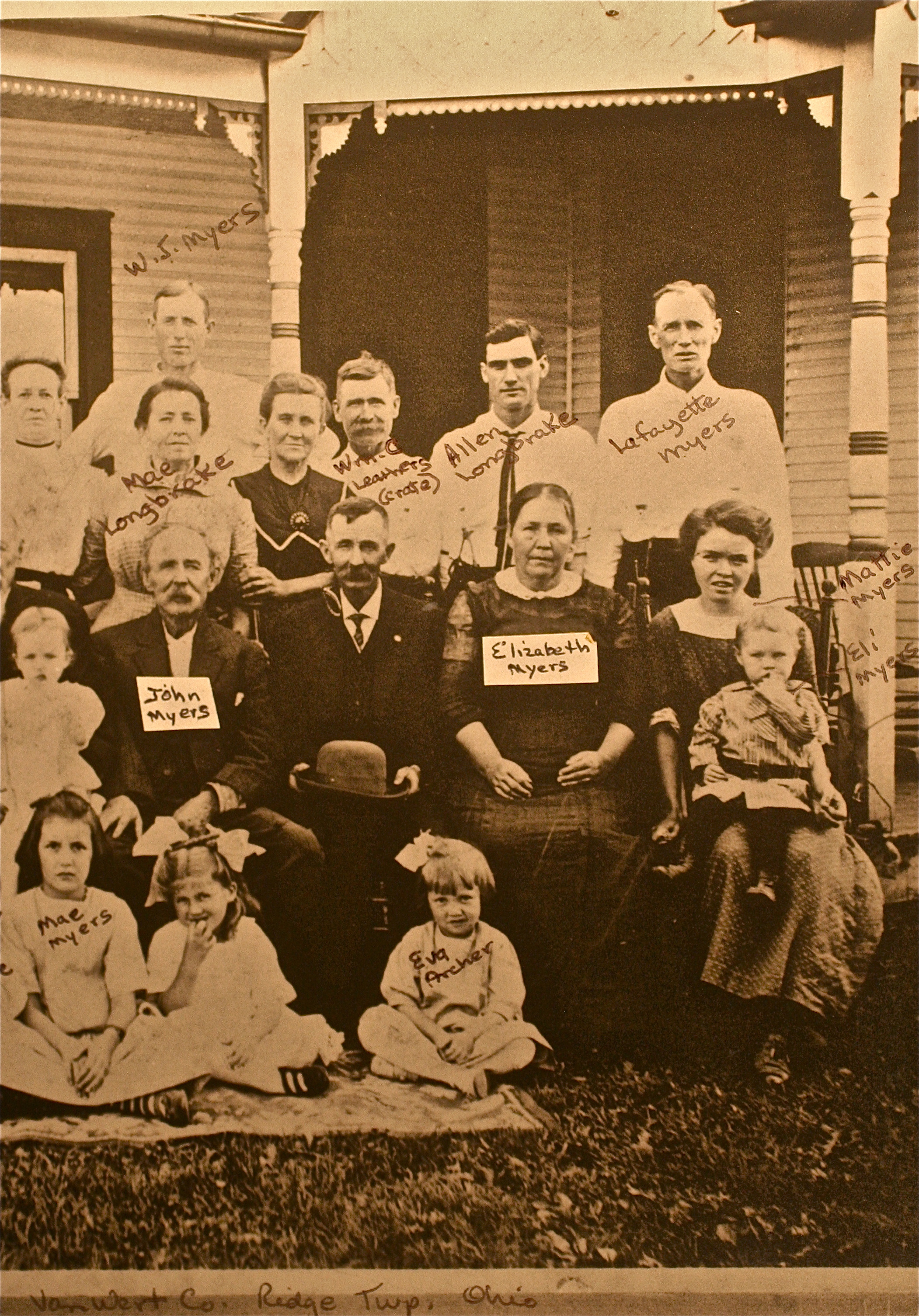
My paternal great-great grandfather John Myers owned our first farm in the U.S., probably in Fairfield County Ohio where his son Lafayette was born in 1861. It likely was was a few acres of low rolling hills that still are better suited to small farms than large-scale grain production.  To this German-speaking immigrant from Basel the land must have looked like home – even today it resembles the fields east of Munich.  A surviving family portrait from about 1912 is framed by the white porch of a farmhouse in Ridge Twp, Van Wert County Ohio. This remarkable photograph includes John, his son Lafayette, Lafeyette’s wife Elizabeth, and the oldest (William J.) and youngest (Jennie Mae) of Lafayette and Elizabeth’s 10 children.

Family and friends, 1912

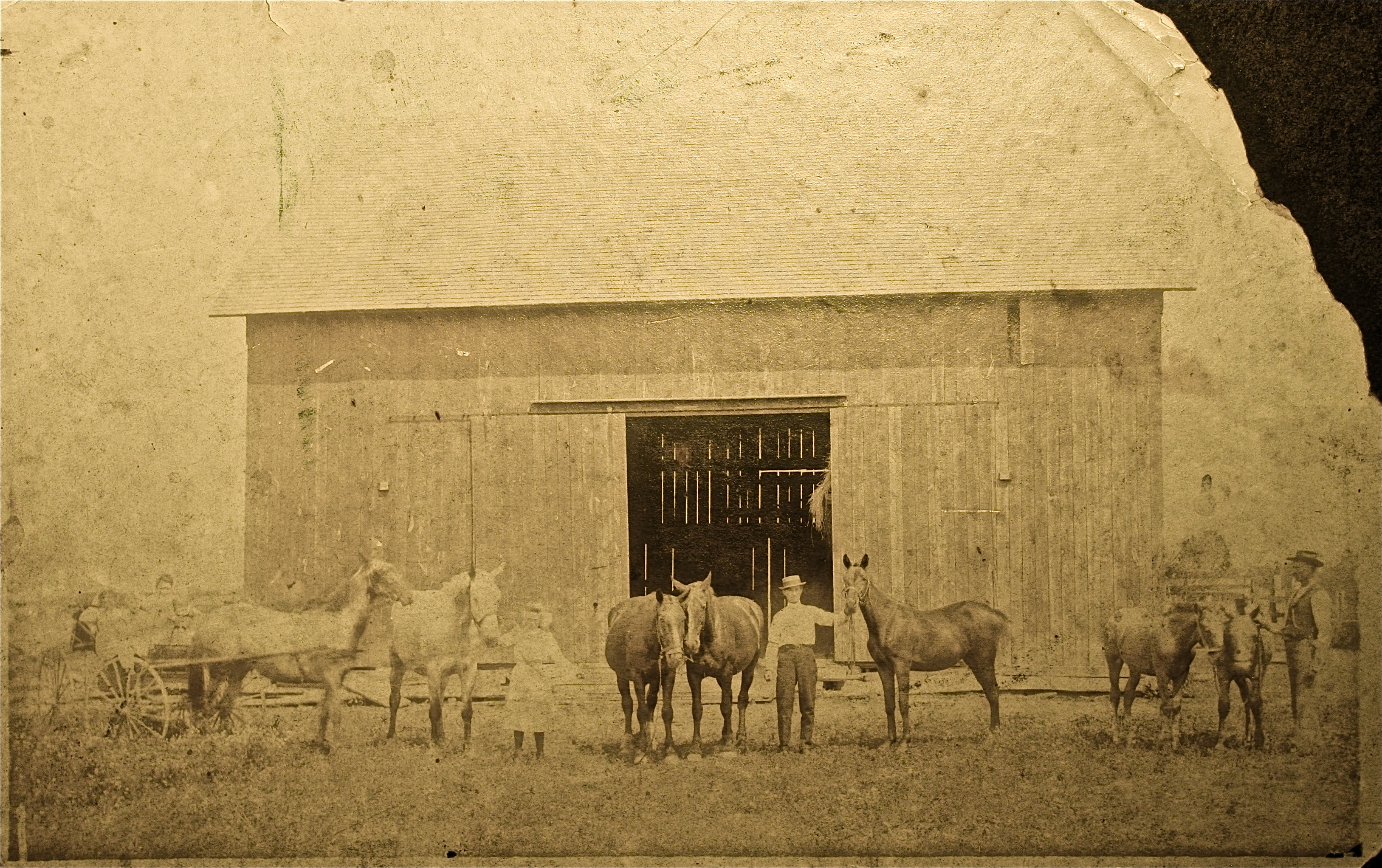
A biographical sketch of William J. Myers, my grandfather, written by my father describes him as “a farmer at heart” although he worked at a variety of jobs over his 86 years. Between 1925 and 1965 he farmed up to 80 acres. I remember only two of my grandfather’s barns. Both were well-seasoned, having housed working horses and cattle, corn and hay. For a boy growing up in Detroit time spent there with gram’pa offered a glimpse of his completely different lifestyle, a first tractor ride, and the smells and sounds of the livestock. There was also a sense of his ownership, from the heavy barn doors that took a man’s shoulder to open to the high stacks of baled hay in the loft that was my playground.

W.J. Myers, Wife Ethel and children, about 1925

The nine-cornered farm begins

In late October 2010 deep old furrows and groups of bush-hogged stumps bore no relationship to the irregular outlines of the property that was to become the farm.  A survey showed that nine corner posts would be needed for property lines created by multiple adjacent plats and subsequent divisions of ownership.  The northwest corner was defined by an old oak tree, another was a bend in an otherwise straight boundary on the north.  Because the southwest corner was at the crest of a small hill new markers would be needed to define the south and west boundaries, and at some points the “rediscovered” property line was closer to decades-old summer cottages than we, or their owners, expected.  When  the last leaves had fallen in the wooded area to the west dense underbrush was no longer a barrier and a few posts were driven to identify the boundary of the adjacent Woodland Conservancy.   Lake-effect snow is abundant at Paw Paw lake, and as it blew off Lake Michigan and buried the stubble and stumps it was time to begin planning the Bluecircle farm.